For most of the history of B2B selling, the salesperson held something the buyer needed: information. The buyer had to take the meeting to get it. Access to information was the seller’s source of value, and much of the sales profession was built on that advantage.
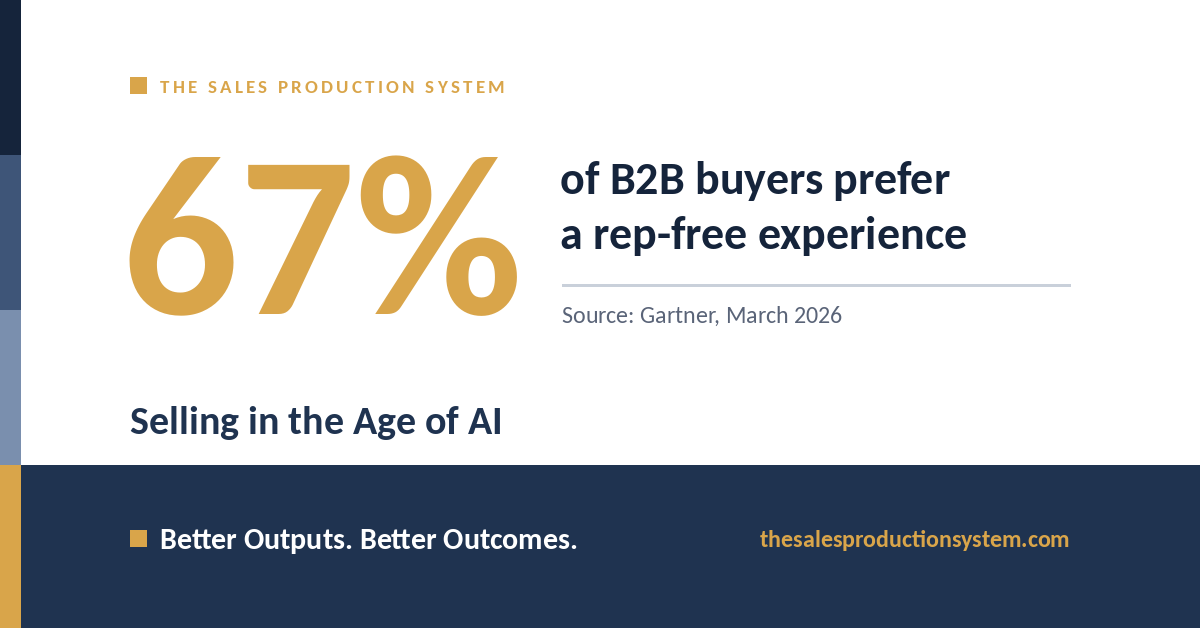
That advantage is gone. Your buyer now arrives with a summary of your product, your competitors and, in all likelihood, the objections they plan to raise, often assembled by an AI assistant before anyone on your team knew the account was in market. Gartner reported in March 2026 that 67% of B2B buyers surveyed prefer a rep-free experience, and 45% said they used AI during a recent purchase.
So the question every sales leader must answer is a simple one. If the salesperson is no longer the source of information, what exactly is the customer getting from them?
My answer: the customer is getting the work. Specifically, the quality of the Outputs the salesperson produces, and the behaviors that produce them.
Information is now a commodity
When everyone has the same information, information stops differentiating. A rep who leads with features, a generic deck and an industry overview is delivering a product the buyer already owns.
What the buyer cannot get from a search bar is a diagnosis of their own situation. They cannot get an honest assessment of what the problem costs them, who else it touches, or what a sound decision process for their organization looks like. Gartner’s 2025 research points the same way: buyers favor self-service for general information, but prefer seller input for tasks requiring what Gartner calls contextual intelligence, such as determining whether a solution fits their company’s needs.
In other words, the buyer no longer needs a messenger. They need a diagnostician, and they need someone to help run a decision process they can trust.
Outputs are the value
In the Sales Production System, Outputs are the tangible work products of the sales team: the discovery notes, the opportunity analysis, the mutual close plan, the business case, the proposal. In the age of AI, these Outputs are no longer internal paperwork. They are the value the customer receives:
- Discovery notes that capture the problem in the buyer’s words, with numbers attached, show buyers their own situation more clearly than they may have seen it before.
- A mutual close plan is a decision process the buying group can actually execute, with names, dates and dependencies, rather than a hope.
- A business case that quantifies the cost of inaction is the document the champion carries into the room when the seller is not there.
Each of these can be built to a specification and inspected against it. That is what separates an Output from an activity. An activity can be counted. An Output can be measured against a quality standard, and so can the behaviors that produce it: the questions asked, the evidence gathered, the next step secured. Those behavior and performance indicators are the leading measures of whether value is being delivered at all.
AI amplifies whatever system you already have
AI is genuinely useful here. It can draft the follow-up, summarize the call and assemble a first-pass proposal in minutes. AI automates execution. What it does not do is decide what good looks like. That decision belongs to your salespeople and managers, exercising their judgment against a defined standard, and it becomes more valuable, not less, as execution gets cheaper.
AI is a force multiplier on a sales production system, not a substitute for one. It amplifies whatever operating system exists. Point it at a line with clear specifications and it accelerates quality. Point it at a line with none and it accelerates defects.
I once saw this play out with an AI call-scoring tool. It awarded a rep full credit on Metrics for a call in which the only relevant question was “What are your challenges?” No numbers were discussed. No cost was established. The tool saw the topic and scored the evidence as present. The dashboard looked healthy; the defect went downstream uninspected. The problem was not the AI. The problem was that no one had told it what Metrics evidence must contain. Without a quality standard, AI scoring does not reduce noise. It scales it.
Where the defects start
When I trace defects back through a sales line, most of them lead to the same station: shallow discovery. And most of the time, the root cause is the same. No one checked the spec.
The Hedged Proposal is a common symptom. A rep sends a good-better-best proposal with three options and three price points. More often than not it is a confession: discovery never established what the buyer needed, what it was worth to them, or what a decision would require, so the rep covers every possibility and lets the buyer do the diagnosis.
AI makes this defect easier to produce: a polished three-tier proposal can be generated from thin notes in moments. It will look finished. It will not be fit for purpose.
Trust is built in the work
There is also the matter of trust. Buyers are receiving more AI-generated outreach than ever, much of it fluent and almost none of it specific. Gartner found that 73% of B2B buyers actively avoid suppliers who send irrelevant outreach. When anyone can produce a convincing message, a convincing message proves nothing.
What still proves something is evidence that the seller listened. Discovery notes that reflect the buyer’s actual numbers. A close plan that names the right people. A business case the CFO cannot easily dismiss. These are hard to fake.
A fair counterpoint
Some will argue that relationships still matter most: people buy from people, and no Output replaces a trusted advisor. I agree that relationships matter.
But a relationship in the age of AI is earned through demonstrated competence, not proximity or persistence. The buyer trusts the seller whose last three deliverables were accurate, useful and on time. Relationships are the outcome of quality Outputs delivered consistently. They are not a substitute for them, and a relationship built on a Hedged Proposal will not survive a buying committee.
Three questions for sales leaders
Systems, not events, will determine which sales organizations thrive. Define the standard, train to it and inspect against it. You do not need another layer of review to supply the judgment; once the standard is clear, you can trust your sellers and managers to apply it. To start, pull five recent opportunities from your pipeline and ask:
- Would the buyer find this Output valuable on its own? If your discovery notes, close plan or business case were sent to the customer today, would they learn something about their own situation?
- Is there a written specification, and does the Output meet it? If two managers would grade the same Output differently, you do not have a standard yet.
- Is AI scoring against your standard, or its own? If your tools are awarding credit, confirm they are inspecting for evidence, not topics.
Uncomfortable answers mean the value your sellers deliver depends on individual talent rather than a system.
That is the work of the Sales Production System: defining the Outputs your sales motion depends on, setting the quality standard for each and building the inspection and coaching rhythm that holds the line, with or without AI. The salesperson’s value has not disappeared. It has moved into the work.
Better Outputs. Better Outcomes.
Sources
- Gartner, “Gartner Sales Survey Finds 67% of B2B Buyers Prefer a Rep-Free Experience,” March 9, 2026: https://www.gartner.com/en/newsroom/press-releases/2026-03-09-gartner-sales-survey-finds-67-percent-of-b2b-buyers-prefer-a-rep-free-experience
- Gartner, “Gartner Sales Survey Finds 61% of B2B Buyers Prefer a Rep-Free Buying Experience,” June 25, 2025: https://www.gartner.com/en/newsroom/press-releases/2025-06-25-gartner-sales-survey-finds-61-percent-of-b2b-buyers-prefer-a-rep-free-buying-experience
Leave a Reply